
What Every Bride Needs to Know About Hem Alterations Before Buying Her Gown
Updated: Sep 7
Hi there, future bride! 👰✨ Let's talk about something almost nobody thinks about when they're twirling around a bridal salon in gown after gown: the hem. You're focused on the silhouette, the neckline, and that gorgeous lace — and that's exactly as it should be! But as a bridal seamstress alterations specialist here in Savannah, Georgia, the hem is one of the very first things I look at when a gown comes into my studio. It tells me so much about the love (and time!) it's going to need before it's truly yours.
So before you say yes to the dress, let’s have some fun and dig into what makes a hem simple or seriously involved. This way, you can walk into your fittings feeling confident, informed, and excited instead of surprised.

Why the Hem Matters So Much
Here's a little insider secret: a wedding gown hem is almost never "just shortening a dress." It's honestly one of the most labor-intensive parts of the whole alterations process! It has to account for your final shoe height, the way you carry yourself, and how the fabric moves when you walk down the aisle. For many gowns, a bustle must work in perfect harmony with whatever hem finish we choose.
Get it right, and your dress moves like magic. Rush it, and it's one of the fastest ways a stunning gown ends up looking unfinished on the big day. I take a lot of pride in getting this part right for my Savannah brides!
The Main Types of Hems
Blind Hem (Standard Fold Hem)
This is the classic! The fabric is folded under and stitched invisibly from the inside, so no stitching shows on the outside at all. It's the go-to hem for simpler gowns in satin, crepe, or mikado. This option is usually the friendliest for your budget since it's a clean, straightforward technique.
Horsehair Braid Hem
This is one of my favorites to talk about because it's the secret behind that gorgeous, full "bell" shape you see on ball gowns and dreamy A-line skirts. A stiff, translucent braid gets sewn right into the hem edge to give the skirt body and bounce. It keeps the fabric from dragging or collapsing. It’s a little more time-consuming to attach evenly, especially around curves, so it does add to the cost. But oh, is it worth it for that silhouette!

Rolled or Baby Hem
A delicate, narrow little hem, usually rolled by hand or with a special rolled-hem foot. This hem is most often seen on airy chiffon, georgette, or organza. It's absolutely lovely and lightweight, but because we're working with slippery, sheer fabric, it takes a slow and very careful hand. This one's truly a labor of love!

Faced Hem
Instead of folding the gown fabric itself, we attach a separate strip of fabric (a "facing") to the hem edge and turn that under. This is common on structured fabrics like mikado or duchess satin, or on gowns with heavy beading or embellishment along the edge that just can't be folded under.
Lettuce Hem
A playful, wavy, ruffled finish, typically done on chiffon or lightweight jersey by stretching the fabric as it's stitched. It’s a specialty technique, often done with a baby hem serger, and it adds the sweetest bit of movement and romance to a skirt's edge.
Raw or Deckle Edge
Some fabrics, especially certain silk organzas, are designed to fray just a touch and are left unfinished on purpose for a soft, ethereal look. It sounds simple, but trust me, getting an even, intentional-looking raw edge takes a real trained eye!
Fabric Type: Why Some Cost More to Hem Than Others
Here's something that surprises many brides: not all wedding gown fabrics behave the same way under a needle. That difference shows up directly in your alterations invoice. Let’s break it down!
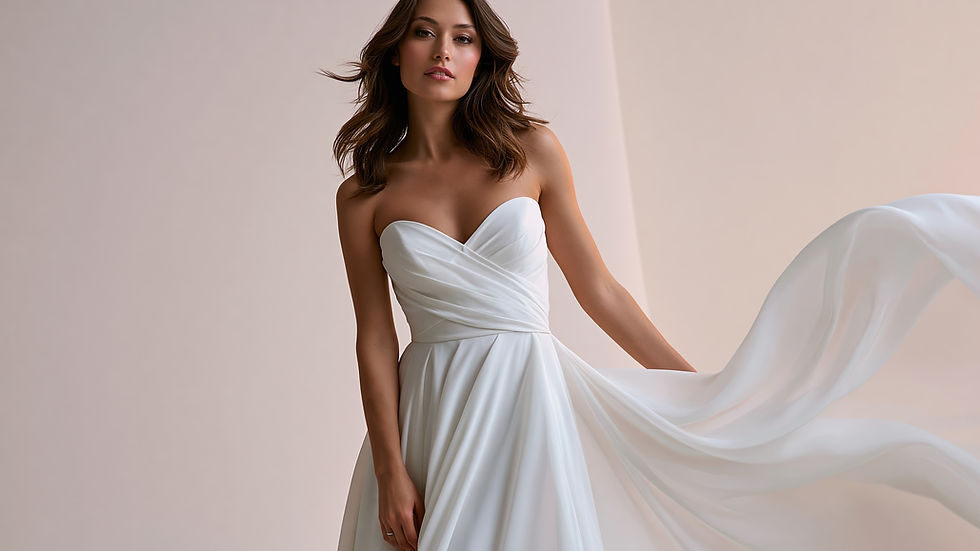
Chiffon, georgette, and silk organza — These dreamy, sheer, lightweight fabrics are gorgeous for movement. However, they are a challenge to hem cleanly! They shift around while being pinned and sewn, fray easily, and usually need to be hand-finished rather than machine-finished. This is consistently one of the more special-care (and pricier) fabrics to hem, but the flowy payoff is so worth it.

Tulle and netting — Good news: tulle doesn't fray! However, it’s often layered many times over. Cutting all those layers evenly without a choppy look takes a really practiced eye.
Satin and mikado — These fabrics are more stable and easier to control than chiffon. However, they show every single needle mark and pinhole, so precision is everything. They also hold a wonderfully crisp edge, which is why they're so popular for structured ball gowns.
Lace — Lace hems are in a category all their own! If the lace has a scalloped or motif edge, I often hand-appliqué each little lace motif along the new hemline. This preserves that gorgeous pattern instead of just cutting straight across it. It’s meticulous, slow, beautiful handwork — and it’s priced to match the artistry involved.
Crepe — A relatively forgiving, matte fabric that folds cleanly and behaves nicely. This is typically one of the friendlier fabrics for your alterations budget.
Here's the general rule of thumb: the more a fabric moves, frays, or shows every little imperfection, the more special, careful handwork it needs. That's what shows up in the cost, rather than a quick pass through the machine.
How the Number of Layers Affects Your Price
Okay, this is the part that surprises brides the most, so let’s really dig in! A gown isn't just "one hem" — it's every single layer of that skirt, hemmed individually so they all fall together perfectly.
A simple sheath gown might just have a lining and one outer layer — easy, two layers to hem. But a dramatic ball gown? That can have a structured underskirt, multiple layers of tulle for volume, and an outer layer of lace or organza on top. Sometimes, it can have five, six, or even more layers total! Each one gets measured, marked, and hemmed on its own, often at a very slightly different length to create that perfect silhouette.
It’s simply not something we can treat as one thick stack of fabric and call it done. More layers mean more time at my sewing table, more precision to keep everything even, and — especially with tulle — more careful trimming so there's no visible cut edge. That’s why a beautifully layered ball gown will almost always cost more to hem than a slim, single-layer silhouette, even if we’re shortening both dresses the exact same amount.
What to Ask Before You Buy
Before you fall head over heels for a gown, it's worth asking your salon (or your alterations specialist!) a few quick questions:
What fabric is the skirt made of, and how many layers does it have?
Does the hem style include horsehair braid or a structured underskirt?
If there's lace at the hemline, is it a straight edge or a scalloped motif edge?
Knowing the answers won't change how much you fall in love with the dress. However, it will help you plan your budget with confidence and skip the surprises at your first fitting!
Let's Chat, Savannah Brides! 💛
If you're getting married in the Savannah, Georgia area (or bringing your gown here for alterations!), I’d love to help you figure out exactly what your dress will need before you commit to alterations. Every gown — and every bride — is a little different. I genuinely love walking brides through this process at my Savannah studio. Reach out anytime, and let’s get you ready to walk down that aisle feeling absolutely radiant!
Remember, the right alterations can transform your special occasion garment into something truly magical. Let's make sure your gown fits you perfectly!


Comments